CLOSE
MENU
A Clear Vision for a Cleaner Future

A Clear Vision for reducing our emissions

Sustainability is no longer the exception. It’s the expectation. Our customers, investors and other stakeholders are looking for us to embed sustainability into our business. We are committed to achieving Net Zero by 2050 – balancing the emissions we generate with those offset or removed from the atmosphere – to reduce the impact of every product we produce. To achieve this commitment, we must understand where we need to act and then move forward, united across our global operations.


In 2024, we identified the physical and transitional risks to our business that are associated with climate change, analyzed the financial implications and developed a roadmap to achieve a carbon reduction target. This climate risk assessment and scenario analysis informed our level of climate commitment and helped us prepare for regulatory reporting, including our 2025 California Climate-Related Financial Risk Disclosure.


This assessment allowed us to prioritize our carbon reduction initiatives, but we still needed to focus our global efforts to drive progress at scale. The establishment of our sustainability framework, The Broader Perspective, does just that. It frames our organizational sustainability efforts into three key areas – emissions reduction, waste reduction and innovation – so we can make universal progress across our global footprint. Now, we can see further, identifying a clear path forward, and act together to make progress at scale.


Every step of our organization – from sourcing raw materials to manufacturing finished products – generates emissions. Each reduction helps lower our impact and move us closer to our Net Zero by 2050 commitment. That’s why emissions reduction sits at the core of our sustainability efforts. While we have begun measuring and exploring ways to reduce our Scope 3 emissions (indirect emissions from our value chain), our net zero commitment is focused on the emissions we have more direct control over – Scope 1 (direct fuel use) and Scope 2 (electricity). If no action is taken, our emissions are expected to grow 116% through 2050 with purchased electricity being our largest source of emissions historically. 


What is Bausch + Lomb doing to reduce energy use at its facilities?

  • Continuing implementation of annual 10% reduction FEWW goals (Fuel, Energy, Water and Waste) at our global manufacturing sites
  • Focusing on targeted operational improvements and scalable, site-level initiatives including implementing recommendations from third-party energy audit reports 
  • Developing an Energy Reduction Playbook to standardize universal reductions at our sites 

What is Bausch + Lomb doing to reduce energy use at its facilities?

Universal progress starts with strong foundational processes. For years, our annual FEWW goals at our global manufacturing sites have driven continuous reductions but reaching our commitment requires more. From 2022–2023, many of our sites underwent third-party audits, highlighting efficiency opportunities, potential energy savings, cost for implementation and Return on Investment (ROI) from improvements. In 2024, we outlined how we will systematically reduce our emissions for the first time in our UK Carbon Reduction Plan, laying the groundwork for us to build our Global Carbon Reduction Plan. These plans focus our big picture operational improvements and encourage our employees on the ground to continuously identify reduction opportunities. Together, our reduction plans and site audits have enabled us to prioritize the actions that deliver the greatest benefit, balancing cost and impact. 


But to achieve our Net Zero by 2050 commitment, we must also raise the baseline efficiency of our facilities. We have developed and are rolling out an Energy Reduction Playbook to all our manufacturing sites. This playbook will help each of our global manufacturing facilities track electricity and fuel consumption so we can develop site-specific emissions reduction plans. We implemented this type of process in 2025 by finding ways to improve overall equipment efficiencies (OEEs) and reduce waste in our production processes. We are diligently working to integrate these improvements at all our locations, but the sites that have implemented these improvements are running at record high production rates while decreasing the energy and waste intensities associated with each batch. Beyond increasing efficiencies, these improvements also expand our workforce’s operational excellence and build sustainability stage gates within each step of our production process, from research and development to distribution. The playbook also considers energy shifts from site projects to balance immediate improvements like enabling heat recovery from equipment and installing variable frequency drives with long-term strategy. The Energy Reduction Playbook will enable all our sites to universally and continuously push toward our Net Zero commitment.  

How is Bausch + Lomb improving energy efficiency across all its operations and laying the groundwork for continuous progress? 


  • Maintaining third-party certifications to drive continuous improvement 
  • Combining site-wide energy reduction planning with targeted efficiency improvements


How is Bausch + Lomb improving energy efficiency across all its operations and laying the groundwork for continuous progress? 

The first step to achieving net zero emissions is using less energy. Once rolled out, our site Energy Reduction Playbooks will broaden our efforts. But we are also continuously improving at our facilities by maintaining our third-party certifications like ISO 14001 (Environmental Management System) at many of our manufacturing sites to minimize their environmental footprint, comply with relevant legal requirements and achieve their environmental objectives. We also maintain ISO 50001 (Energy Management System) at our most energy intensive sites, Rochester and Waterford, following its data-driven framework to improve energy performance, lower carbon emissions and reduce cost.


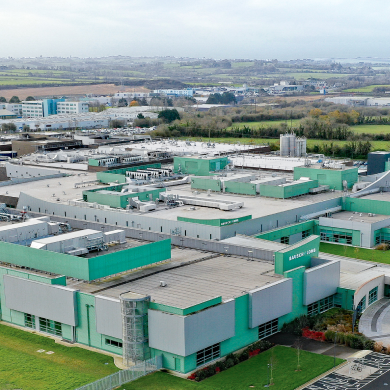
At both of these sites we have turned our learnings into strategic action. At our Waterford, Ireland, manufacturing site, we have implemented two onsite Combined Heat and Power (CHP) systems. These CHP systems enhance energy efficiency and reduce reliance on externally sourced electricity by utilizing natural gas to generate electricity and thermal energy for site operations. This approach allows us to shift some of the purchased electricity to onsite natural gas with a lower emission factor.    At our Rochester site, a detailed analysis of power usage showed that indirect demands – such as HVAC and compressed air – account for roughly 72% of contact lens manufacturing power consumption. That insight led to targeted upgrades that reduce the power needed to produce compressed air by about 10%. Energy reduction on a global scale doesn’t happen overnight – it’s a combination of many intentional actions. By balancing a universal and site-specific approach to equipment upgrades, we continue to reduce our energy use and associated carbon emissions.

How is Bausch + Lomb integrating renewable energy to reduce the greenhouse gas emissions it generates?


  • Generating renewable energy through onsite solar
  • Transforming carports into energy generation 
  • Purchasing certified renewable energy through Power Purchase Agreements


Generating renewable energy through onsite solar Transforming carports into energy generation

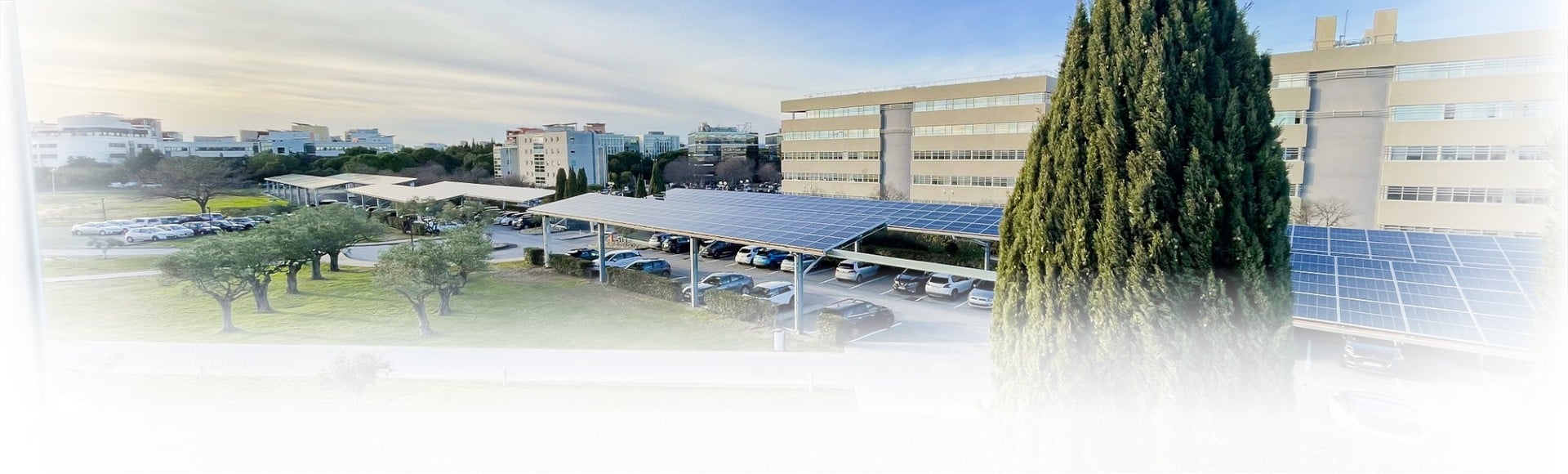
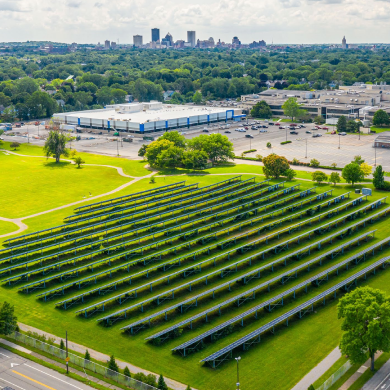
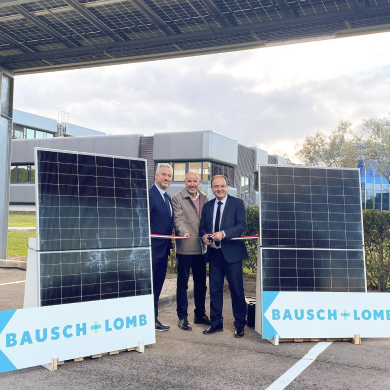
The other half of the net zero equation is integrating renewable energy. We’ve installed onsite solar at our Rochester, Aubenas and Munich facilities. The onsite solar at these facilities generated a combined 5.88 terajoules in 2025, roughly equal to avoiding the emissions of 72,326 gallons of gasoline.* But we aren’t limiting our onsite renewable energy installation to the roofs of our buildings or nearby fields. We recently turned what could have been a typical carport into an onsite solar generation infrastructure at our Montpellier office location. With 1,160 solar panels, this solar carport covers nearly 45% of the Montpellier site’s annual electricity consumption. 


However, it’s not feasible to generate all the energy we use ourselves. Our plan is to continue to expand our onsite solar generation and supplement it with Power Purchase Agreements (PPAs) with our utility providers over time. By 2050, purchased renewable energy is expected to account for nearly 41% of our emissions reduction and another 28% reduction is expected from the decarbonization of the electrical grids that service our facilities. 


And we’ve already begun implementing PPAs. In 2025, our Sterimedix and East Sussex manufacturing sites covered 100% of their electricity consumption with certified renewable energy. Additional sites will be prioritized in the U.S., Europe and Asia for PPAs as utility contracts come up for renewal and the opportunity is economically feasible. Together, expanding our onsite renewable energy capacity and supplementing it with purchase agreements enables us to scale our renewable energy to meet our Net Zero commitment. 

A Clear Framework for Consistent Progress

Achieving Net Zero by 2050 is challenging, but it’s possible. By measuring, understanding and monitoring our emissions, we can build on our existing efforts with targeted energy reduction and renewable energy initiatives. We can see further and act together. This is The Broader Perspective: looking beyond individual actions to create progress that benefits our business, our industry and future generations. As we continue on our sustainability journey, this framework enables us to mitigate the negative impacts of our resource consumption on communities and the environment – to help people see better to live better.

A Clear Framework for Consistent Progress

*Equivalencies derived using the EPA Greenhouse Gas Equivalencies calculator.